
Optimistic Concurrency
Optimistic Concurrency
Overview
Locking is a pessimistic approach to concurrency control.
- Limit concurrency to ensure that conflicts don’t occur.
Costs: lock management, deadlock handling, contention.
In scenarios with far more reads than writes:
- Don’t lock (allow arbitrary interleaving of operations).
- Check just before commit that no conflicts occurred.
- If problems, roll back conflicting transactions.
Optimistic concurrency control (OCC) is a strategy to realise this.
Stages of OCC
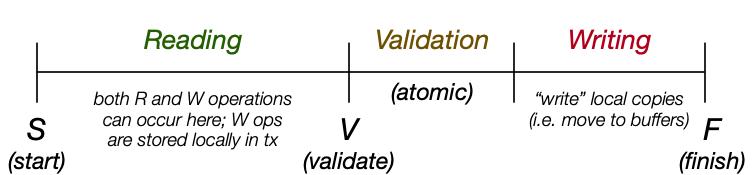
OCC has 3 distinct phases:
- Reading: read from database, modify local copies of data.
- Validation: check for conflicts in updates.
- Writing: commit local copies of data to database.
Validation
Data structures needed for validation:
- S: set of txs that are reading data and computing results.
- V: set of txs that have reached validation (not yet committed).
- F: set of txs that have finished (committed data to storage)/
- For each
T_i, timestamps for when it reached S, V, F. RS(T_i): set of all data items read byT_i.WS(T_i): set of all data items to be written byT_i.
Use the V timestamps as ordering for transactions.
- Assume serial tx order based on ordering of
V(T_i)’s.
Two-transaction Example
Overview:
- Allow transactions
T_1andT_2to run without any locking. - Check that objects used by
T_2are not being changed byT_1. - If they are, need to roll back
T_2and retry.
Case 0: serial execution, no problem.

Case 1: reading overlaps validation/writing.
T_2starts whileT_1is validating/writing.- If some
Xbeing read byT_2is inWS(T_1). - Then
T_2may not have read the updated version ofX. - So,
T_2must start again.
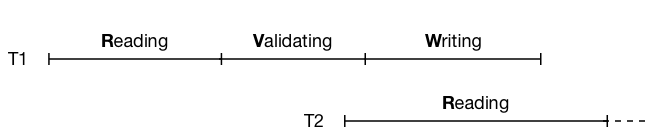
Case 2: reading/validation overlaps validation/writing.
T_2starts validating whileT_1is validating/writing.- If some
Xbeing written byT_2is inWS(T_1). - Then
T_2may end up overwritingT_1’s update. - So,
T_2must start again.
Summary of Validation Checks
For all transactions T_i =/= T:
- If
T ∈ S and T_i ∈ F, then ok. - If
T ∉ V and V(T_i) < S(T) < F(T_i), then checkWS(T_i) ∩ RS(T)is empty.Tmay be reading an old value thatT_ihas changed and not yet committed.
- If
T ∈ V and V(T_i) < V(T) < F(T_i), then checkWS(T_i) ∩ WS(T)is empty.Tmay end up overwriting a value thatT_ihas written.
If this check fails for any T_i, then T is rolled back.
Summary
OCC prevents: T reading dirty data, T overwriting T_i’s changes.
Problems with OCC:
- Increased roll backs.
- Tendency to roll back “complete” tx’s.
- Cost to maintain S, V, F sets.
Roll back is relatively cheap:
- Changes to data are purely local before writing phase.
- No requirement for logging info or undo/redo.