Tuple Representation
Tuple Representation
Records vs Tuples
Tables are defined by a schema, e.g..
create table Employee (
   id   integer primary key,
   name varchar(20) not null,
   job  varchar(10),
   dept smallint references Dept(id)
);
Tuples are collection of attribute values based on a schema. Records are a sequence of bytes, containing data for one tuple. Bytes need to be interpreted relative to a schema to get a tuple.
Converting Records to Tuples

A Record is an array of bytes. - Represents the data values from a typed Tuple. - Stored on disk (persistent) or in a memory buffer.
A Tuple is a collection of named, typed values (similar to C structs). - An interpretable structure is needed to manipulate the values. - Stored in working memory (temporary).
Information to Interpret Bytes in a Record
- May be contained in schema data in DBMS catalog.
- May be stored in page directory.
- May be stored in the record (header).
- May be stored partly in record and partly in schema.
For variable-length records, formatting information is required:
- Must be stored in the record or in the page directory.
- Since it refers to individual records and not the whole table.
- At the least, need to know how many bytes in each variable length value.
Operations on Records
Access record via RecordId:
Record get_record(Relation rel, RecordId rid) {
    (pid, tid) = rid;
    Page buf = get_page(rel, pid);
    return get_bytes(rel, buf, tid);
}
Cannot use a Record directly; need a Tuple:
Relation rel = ... // relation schema
Record rec = get_record(rel, rid);
Tuple t = makeTuple(rel, rec);
Once we have a Tuple, we can access individual attributes/fields (with index).
int x = getIntField(t, 1);
char *s = getStrField(t, 2);
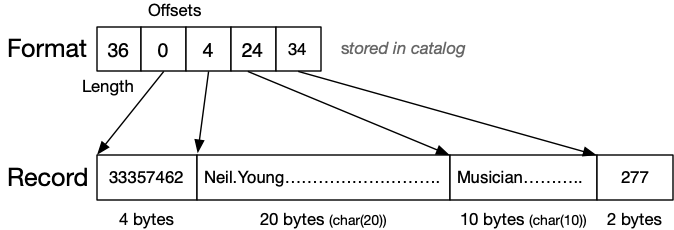
Fixed Length Records
Possible encoding scheme:
- Record format (length + offsets) stored in catalog.
- Data values stored in fixed-size slots in data pages.
Variable Length Records
Possible encoding scheme:
- Prefix each field by length.
- Terminate fields by delimiter.

- Note: similar to C strings.
- Array of offsets.


Data Types
DBMSs typically define a fixed set of base types which have a corresponding implementation-level data type for field values:
| DBMS Type | C Level Type |
|---|---|
DATE | time_t |
FLOAT | float, double |
INTEGER | int, long |
NUMBER(n) | int[] |
VARCHAR(n) | char[] |
Field Descriptors
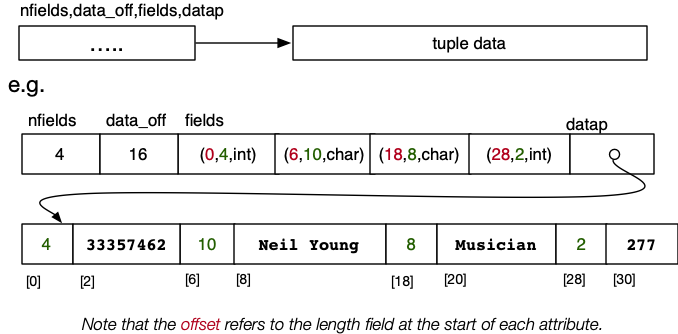
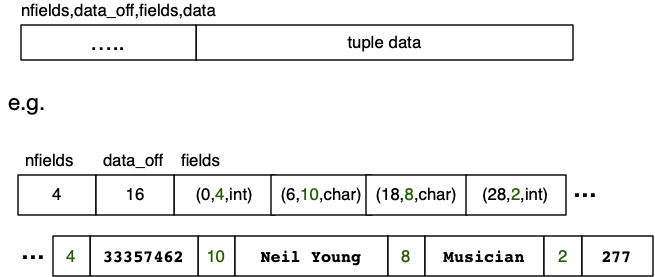
Tuple can be implemented as:
- List of field descriptors for a record instance.
- Where
FieldDescgives(offset, length, type)information.
- Where
- Along with a reference to the
Recorddata.
typedef struct {
  ushort    nfields;   // number of fields/attrs
  ushort    data_off;  // offset in struct for data
  FieldDesc fields[];  // field descriptions
  Record    data;      // pointer to record in buffer
} Tuple;
Fields are derived from relation descriptor + record instance data.
Tuple data could be:
- A pointer to bytes stored elsewhere in memory.
- Or, appended to
Tuple struct(used widely in PostgreSQL).