
SIMC Indexing
SIMC Indexing
Overview
In a SIMC indexing scheme:
- Tuple descriptor formed by overlaying attribute codewords.
- Each codeword is
m-bits long and hask-bits set to 1.
A tuple descriptor desc(t) is:
- A bit-string,
m-bits long, wherej <= nkbits are set to 1. desc(t) = cw(A_1) OR cw(A_2) OR .. OR cw(A_n).
def generateSignature(attributes: List[Attribute], m: int, k: int) -> bits:
    desc: bits = 0
    numAttributes: int = len(attributes)

    for i in range(numAttributes):
        cw: bits = codeword(attributes[i], m, k)
        desc = desc | cw
Queries
To answer query q in SIMC:
- Generate
desc(q)by OR-ing codewords for known attributes.- Unknown attributes will not contribute to descriptor.
- Attempt to match
desc(q)against all signatures in signature file.
def matches(sig: bits, qdesc) -> bool:
    # Ensures all bits set in qdesc are set in sig.
    # sig is allowed to have additional set bits.
        # Possible because it was an unknown attribute in the query.
        # Or false positive match.
    return (sig & qdesc) == qdesc

def query(r: Rel, q: Query):
    pagesToCheck = set()

    for descriptor in r.signatureFile():
        if matches(descriptor, desc(q)):
            pid = pageOf(tupleID(descriptor))
            pagesToCheck = pagesToCheck.union(pid)

    # scan b_sq = b+q + δ pages to check for matches.
SIMC Parameters
Let p_F denote the likelihood of a false match.
Ways to reduce false matches:
- Use different hash function for each attribute (
h_iforA_i). - Increase descriptor size (
m).- Tradeoff: larger
mmeans larger signature file ==> read more signature data.
- Tradeoff: larger
- Choose
kso that ~=** half of bits are set**.- Tradeoff:
- High
k==> increased overlapping. - Low
k==> increased hash collisions.
- High
- Tradeoff:
Choosing Optimal m and k
- Start by choosing acceptable
p_F. - Follow these formulas:
k = 1/ln(2) * ln(1/p_F).m = (1/ln(2))^2 * n * ln(1/p_F).
Query Cost for SIMC
Cost to answer PMR query: Cost_pmr = b_d + b_sq.
- Read
rdescriptors onb_Ddescriptor pages. - Then read
b_sqdata pages for matches.
b_D = ceil(r / c_D) where c_D = floor(B / ceil(m / 8)).
- Recall:
ris total number of tuples.c_Dis capacity of signatures per page.
b_sq includes pages with r_q matching tuples and r_F false matches.
- Expected false matches =
r_F = (r - r_q) * p_F ~= r * p_Fifr_q << r. - Example:
- Worst:
b_sq = r_q + r_f.- All matching tuples on different pages and all false matches on different pages.
- Best:
b_sq = 1. - Average:
b_sq = ceil(b(r_q + r_f) / r).
- Worst:
Page-level SIMC
Alternative SIMC approach: one descriptor for each data page.
- Every attribute of every tuple in page contributes to descriptor.
- Potentially more efficient.
Size of page descriptor (PD):
- Use previous formulas for
mandkbut multiply by number of tuples per page.
File organisation: 
- Note: each signature now corresponds to a page of tuples.
PMR Query Algorithm
def query(r: Rel, q: Query) -> List[Tuple]:
    pagesToCheck = set()

    for i in range(len(r.signatureFile())):
        descriptor = r.signatureFile()[i]

        if matches(descriptor[i], desc(q)):
            pid = i
            pagesToCheck = pagesToCheck.union(pid)

    # read and scan b_sq data pages
    for pid in pagesToCheck:
        # check matching tuples.

    return # matching tuples
Bit-sliced SIMC
Improvement: store b m-bit page descriptors as m b-bit bit-slices.
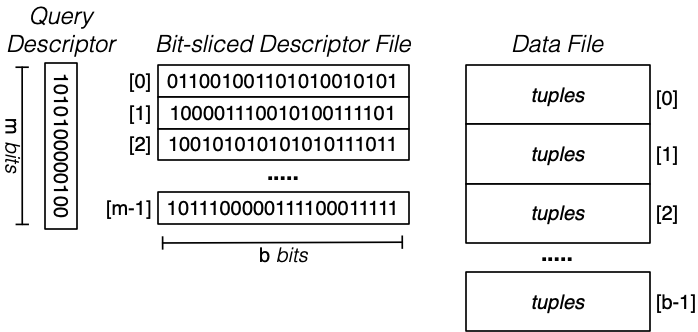
PMR Query Algorithm
matches = ~0 // all ones
// scan m r-bit slices
for each bit i set to 1 in desc(q) {
   slice = fetch bit-slice i
   matches = matches & slice
}
for each bit i set to 1 in matches {
   fetch page i
   scan page for matching records
}
Effective because desc(q) typically has less than half bits set to 1.
Comparison of Approaches
Tuple-based:
rsignatures,m-bit signatures,kbits per attribute.- Read all pages of signature file in filtering for a query.
Page-based:
bsignatures,m_p-bit signatures,kbits per attribute.- Read all pages of signature file in filtering for a query.
Bit-sliced:
m-signatures,b-bit slices,kbits per attribute.- Read less than half of the signature file in filtering for a query.
All signature files are roughly the same size, for a given p_F.